To Avoid Disappointment

Thursday, August 6, 2026


Avoid Disappointment

Avoid Disappointment

Introduction

It can be difficult to manage your expectations and avoid disappointment. On the one hand, you want to believe in yourself and know that your dreams are attainable. But on the other hand, not all of them will come true — at least not exactly as you envisioned them. In fact, great things usually don't happen when everything goes according to plan; they happen when we're willing to take risks and go with our gut feelings instead of going with what's comfortable or safe.

That being said, here are some tips for avoiding disappointment with something that's important to me:

Be the best version of yourself, regardless of what others think of you.

First, you have to be the best version of yourself, regardless of what others think. No matter how much someone tries to bring you down or tell you that your life is useless, don’t let their words or actions get to you. Remember that they are usually unhappy with themselves and have developed a way of coping by making other people feel bad as well. We all know someone who is like this in our life and it isn't fair for them to make us feel bad about ourselves either. This person might not be a good friend but it doesn't mean that we should stop being friends with them because if we do then this person has won again!

There are many things in life which can cause us disappointment but if we stay positive then we will always find ways around disappointment! Be confident in your own skin and don't let other people's opinions dictate your life decisions; instead, focus on moving forward towards achieving your goals no matter what obstacles come along the way

Avoid overthinking.

It’s easy to fall into the trap of overthinking, especially when you are faced with a challenging situation or an uncertain future. You can spend hours running through every possible outcome and coming up with every potential solution in your mind. While this may feel productive at first, it will quickly lead to an overwhelming sense of anxiety and stress as you become more aware of how little control you actually have over what happens.

Overthinking is also a form of escapism; it allows us to remove ourselves from reality by escaping into our own minds where there are no limits or restrictions on our thoughts or emotions. We can create any scenario we want in order for things to turn out favorably for us (e.g., if only I had done X instead). Over time this type of thinking becomes ingrained in our psyche as we begin seeing ourselves as victims rather than as autonomous agents who are responsible for their own lives and decisions (e.g., if only they hadn't said Y then things would be different). This negative mindset brings along feelings such as depression and anger which may result in engaging in destructive behaviors such as overeating/binging watching Netflix binges/etc., which only serve further reinforce these negative thought patterns!

Stay in the present moment.

  • Live in the present. Don't waste your time thinking about what happened yesterday or what's going to happen tomorrow. You can learn something valuable from the past, but dwelling on it doesn't help you grow and change as a person.

  • Don't worry about things you cannot change. It's easy to get stuck worrying about things out of our control—we make plans based on what we think will happen, but often reality doesn't cooperate with our expectations. When you find yourself dwelling on something that's beyond your control, stop yourself and refocus on what you can do right now in this moment of time—and then move forward!

Learn to listen, not hear

Listening is a two-way street. It's not about hearing what people say; it's about hearing what they mean.

You can hear the words, but if you don't listen to the tone and emotion behind them, then your understanding will be incomplete at best and completely wrong at worst. The same word can have multiple meanings depending on how it's said or how it fits into context with everything else being said around it.

When you're listening to someone else talk, pay attention to their body language as well as their facial expressions—both are indicators of what they're feeling at that moment and can help clarify what they're trying to say by giving insight into their true feelings about something instead of just being able to interpret words alone (which sometimes won't tell you much).

Learn the difference between the ego and the soul.

The ego is the part of you that wants to be right and wants to win. It’s the part of you that wants to be successful, get promoted, and make more money. It’s also your inner critic—the voice in your head that says you aren’t good enough, smart enough or worthy enough.

The soul is the part of you that wants to be good and wants help other people. The soul doesn’t care about winning or being right. Instead, it cares about what happens in life beyond just oneself or one's immediate family (or tribe). It cares about making a positive difference in the world on a grand scale—through acting with kindness towards others and helping people who are less fortunate than we are ourselves through acts of charity or philanthropy; through working at something bigger than ourselves; through setting an example with our actions; by using our talents for good rather than evil...

Practice self-love.

  • Practice self-love.

  • You need to love yourself before you can truly love others, so it may be helpful to put in a little extra effort in this area. As the saying goes, “you are your own worst critic”—so what does that look like? It might mean taking a moment every day to write down something nice about yourself or making sure that you catch yourself before criticizing your appearance or thoughts too harshly.

In addition to being kinder toward ourselves, we also need to be more aware of how we treat ourselves when things don't go our way or don't go according to plan. Try not to let negative thoughts spiral out of control; instead, try reframing them into something positive such as “I made an honest mistake and will learn from it next time." Or simply remind yourself that even if things aren't going according to plan right now (and they rarely do), there's always another chance tomorrow!

You can't always control what happens but you can control how you react to it

It's hard to avoid disappointment when we allow ourselves to be disappointed. We can't control what happens in life, but we always have the option of how we react. Sometimes the best way to deal with disappointment is by not letting it dictate your future. Don't let what happened in the past define who you are today or who you will become tomorrow. Make sure your own self-worth doesn't depend on other people's opinions of you either because that could lead to depression if you don't agree with those opinions.

Don't compare yourself to impossible standards.

Don't compare yourself to impossible standards.

As humans, it's easy for us to get lost in the comparison game. We look at someone else and think that they have a perfect life or career; then we compare ourselves and realize that we don't measure up. But this kind of thinking can be seriously damaging to your self-esteem and confidence—and ultimately, it can hold you back from achieving what you want in life.

There are two ways you can avoid feeling disappointed when comparing yourself: First, remember that there's no such thing as a perfect person; everyone has flaws (even the people who seem like they are flawlessly put together). Second, remember that everyone experiences pain and struggle; if someone else seems like their life is better than yours now, don't assume that means their future will always be better too!

Don't expect others to live up to your own values..

Don't expect others to live up to your own values.

In the same way that you are not perfect, neither is anyone else. Expecting others to be perfect is a surefire recipe for disappointment and frustration. You may find yourself getting angry at them when they don't act or behave exactly as you expect them to, but it's important that you remember that this isn't their fault—it's yours! You have created these high expectations for yourself and then attempted to impose them on others. It's unlikely they'll feel comfortable conforming in this way; after all, who likes being told what to do?

Sometimes you have to accept that things don't always go as planned.

Sometimes, the best you can do is accept that things won't go as planned. Acceptance is the first step towards change. If you can't change something, at least you can change your attitude about it. The difference between acceptance and resignation is subtle but important: accepting reality doesn't mean giving up hope or being resigned to something negative happening—it means accepting that things are what they are and finding a way to make the most of them.

Acceptance doesn't mean that we don't want improvement; on the contrary, it helps us improve because when we're able to accept our situation instead of fighting against it, we're better able to act rationally rather than emotionally (which leads us down a path towards more frustration). It's possible for example for someone who has lost their job due to layoffs at their company but decides not having one isn’t worth being depressed over—instead focusing on how they'll spend their time differently now or planning how they can find another job after some time off work—that person might feel better than someone who feels defeated by losing his/her job (or worse yet angry) even though both situations require acceptance before moving forward with plans/actionable steps!

Conclusion

We all need to learn these lessons at some point in our lives. We have to accept the fact that sometimes our plans don't work out and there is nothing we can do about it. We also have to realize that it's okay to feel disappointed because it's an emotion that everyone has experienced before us. The important thing is not letting those feelings stay too long because they might lead us down a path of depression or worse!


Never abuse someone's trust.

Saturday, August 1, 2026


Never abuse someone's trust.

Never abuse someone's trust.

Introduction

I've always believed that trust is a fragile thing, and that we need to treat it with utmost care. I believe that you should never abuse someone's trust no matter what.

Do not take advantage of a person.

  • Do not take advantage of a person's vulnerability.

  • Do not take advantage of a person's trust.

  • Do not take advantage of a person's kindness.

  • Do not take advantage of a person's generosity.

  • Don't use anyone's good nature against them or make someone feel bad about themselves because they have helped you in some way before, no matter how small that help may be - it still counts!

Don't violate the sacred bond of trust.

You can do this by being trustworthy and keeping your word. When you promise to do something, follow through. If you tell someone something in confidence, don’t share that information with anyone else. It takes a lot of trust for people to open up with each other; so when they do that with you, acknowledge it and honor their trust by being trustworthy yourself.

Be mindful of the sacred bond of trust that exists between friends, family members and coworkers. Don’t violate another person's trust in an effort to gain or maintain power over them—it'll only backfire on you in the long run

Conclusion

These are all important points to keep in mind when you're working with a client, whether you're an agency or freelancer. As a freelancer, it's easy to get caught up in the moment and forget that your job is ultimately to serve the client by providing them with quality work and service. But we hope these guidelines will help ensure that everyone has a good experience working together—and that you never abuse anyone's trust again!


Never abuse someone's trust.

A Strong Mind

Monday, July 20, 2026

Don't let your feelings for a certain person or a certain situation cloud your judgment.


Don't let your feelings for a certain person or a certain situation cloud your judgment. There are times to let the heart lead and there are times to let the mind take the helm. keep your feelings under control! Hone your mind to do this and everything will be much easier in life.


Don't let your feelings for a certain person or a certain situation cloud your judgment.

Overcoming in Life

Wednesday, June 3, 2026


Life can become overwhelming at times.

 Overcoming in Life

Life can become overwhelming at times. You might feel that nothing is going according to your plan. Some days seem to go on forever, while others seem like a blur. You might feel numb or nothing at all and feel everything the very next moment. The thing about life is that every day brings new hurdles and that is not necessarily a bad thing as long as you know how to look past those things. Continuous effort is needed to overcome whatever comes your way. Here is how you can make it through the worst of times.

1. Change Your Perspective

One of the most important things that you need to do if you want to overcome difficulty in life is to shift your perspective. At the end of the day, it all comes down to how you look at things. Whenever you come across something challenging, you are likely to feel overwhelmed or even negative about it. One thing can lead to another. To make sure that you remain in the right set of mind, you just have to tweak your view of things. When you change your perspective, you get to wear a completely different lens and twist away from the negativity. Never let your energy go wasted on anything that is not worth pursuing.

2. Learn From Others

Everyone goes through difficult times in life. It is what binds us together and allows us to relate with one another. Chances are that there is someone out there whom you can learn from. It will provide you with great solace knowing that someone has been through similar circumstances or even worse. Even if the person made it out unharmed, it does not make their story any less credible and worth listening to. You can look around you or check the internet as there has to be a celebrity or even a family member who has been where you are. Therefore, you can learn from their experience.

3. Always Feel Free to Ask for Help

There is just so much that you can do on your own. You should never be afraid of asking for help. Even though you might be pessimistic about seeking help from others thinking that you came into this world alone, it is always better to find support. The world has only been successful due to our interdependence on one another. Besides, there is nothing wrong with asking for some help now and then.

4. Come Up With a Solution

Instead of dwelling on your problem, you should think of a solution to put an end to it. There is a solution for just about everything, even heartbreak. No matter how tall the hill might seem, you will be able to climb it and make it out alive. It all starts with small steps. You cannot expect to reach the top without any effort and that is the fun in it.

Conclusion

Overcoming difficulties in life might seem impossible. However, everything is possible with the right mindset. By changing your perspective, learning from others, asking for help, and coming up with a solution, you get to overcome just about everything that comes your way.


Overcoming in Life


Overcoming in Life

I am not obligated.

sometimes you really do just have to step right on over certain people and leave them in their negativity for the sake of your happiness.

tired


How to Cultivate Resilience and Stay Strong in the Face of Challenges


 From Wilted to Wonderful.

As we journey through life, we often encounter challenges and obstacles that can leave us feeling withered and worn. These challenges can take many different forms, from personal struggles and setbacks to global crises that affect us all. However, while it can be easy to feel defeated in the face of these challenges, it is important to remember that we are resilient and capable of overcoming even the toughest obstacles.

One of the keys to overcoming challenges and staying strong in the face of adversity is to focus on our own personal growth and development. This means taking the time to reflect on our experiences and learn from them, as well as setting goals and working towards them. By focusing on our personal growth, we can build the resilience and inner strength we need to face whatever challenges come our way.

Another important factor in staying strong and resilient is our relationships with others. Having a strong support network of friends, family, and other loved ones can make all the difference when we are going through tough times. Whether we need someone to talk to, someone to help us with practical tasks, or just someone to offer a kind word or a listening ear, having people in our lives who care about us can help us to stay strong and keep going, even when things seem impossible.

In addition to building our own resilience and cultivating strong relationships with others, it is also important to be proactive in addressing the challenges and issues we face. This means taking action to address the root causes of problems, whether they are personal or societal. Whether we are working to overcome a personal setback or to advocate for change on a larger scale, taking action can help us to feel empowered and motivated to keep going, even when the going gets tough.

Of course, staying strong and resilient is not always easy. There will be times when we feel overwhelmed, discouraged, or uncertain. However, by staying focused on our personal growth, building strong relationships with others, and taking action to address the challenges we face, we can build the inner strength and resilience we need to keep going, even in the toughest of times.

One of the most powerful ways to build resilience and stay strong in the face of adversity is to cultivate a positive mindset. This means focusing on the positive aspects of our lives and being optimistic about the future, even when things are difficult. By adopting a positive mindset, we can build the inner strength and motivation we need to keep going, even in the toughest of times.

One way to cultivate a positive mindset is to practice gratitude. By focusing on the things we are grateful for in our lives, even when things are tough, we can build a sense of perspective and appreciation that can help us to stay positive and motivated. Whether we are grateful for our health, our loved ones, or just the small moments of joy that we experience in our daily lives, cultivating gratitude can help us to stay focused on the positive and keep going, even when things are tough.

Another way to cultivate a positive mindset is to focus on our strengths and accomplishments. By recognizing the things we have achieved and the strengths we possess, we can build a sense of confidence and resilience that can help us to face challenges with more optimism and determination. Whether we are celebrating a personal accomplishment or recognizing the strengths we bring to a particular situation, focusing on our positive qualities can help us to stay strong and motivated, even when things are difficult.

In conclusion, while we may face many challenges and setbacks in our lives, we are not destined to stay withered and worn. By focusing on our personal growth, building strong relationships with others, taking action to address the challenges we face, and cultivating a positive mindset, we can build the resilience and inner strength we need to keep going, even in the toughest of times. So let us remember to stay focused on our personal growth, build strong relationships with those around us.


How to Cultivate Resilience and Stay Strong in the Face of Challenges

The Life-Changing Power of Cherishing the Storm

Wednesday, April 15, 2026


The Life-Changing Power of Cherishing the Storm


Cherishing the Storm

Storms are an inevitable part of life. While they may bring turmoil and upheaval, they also provide opportunities for growth and transformation. In this article, we will explore why it is important to cherish the storm and how it can benefit us in the long run.

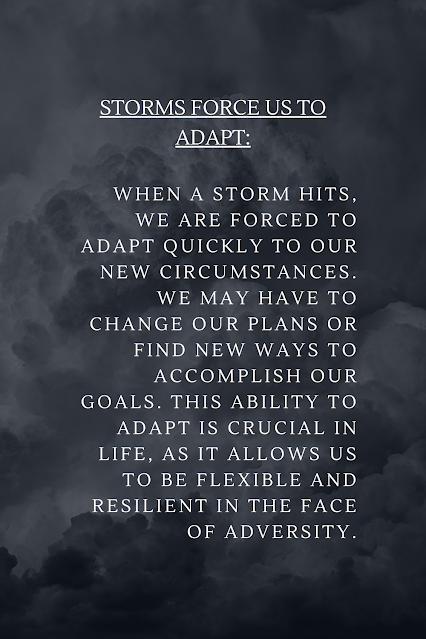
Storms force us to adapt: 

When a storm hits, we are forced to adapt quickly to our new circumstances. We may have to change our plans or find new ways to accomplish our goals. This ability to adapt is crucial in life, as it allows us to be flexible and resilient in the face of adversity.

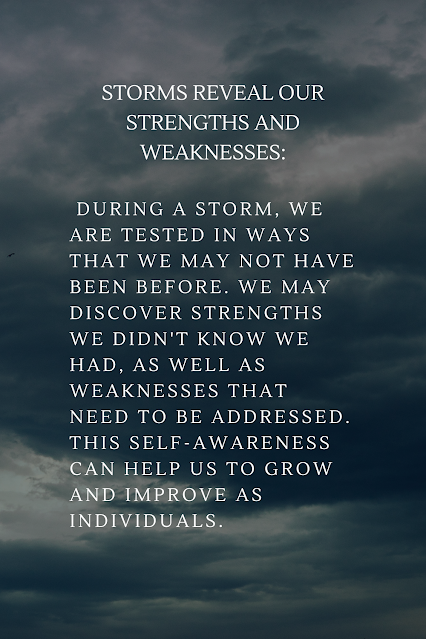
Storms reveal our strengths and weaknesses: 

During a storm, we are tested in ways that we may not have been before. We may discover strengths we didn't know we had, as well as weaknesses that need to be addressed. This self-awareness can help us to grow and improve as individuals.

Storms create opportunities for growth: 

When we are faced with challenges, we have the opportunity to learn and grow from them. Whether it's learning a new skill, improving our communication, or developing our resilience, storms provide fertile ground for personal growth.

Storms teach us to appreciate the calm: 

After a storm has passed, we often feel a sense of relief and gratitude for the calm that follows. This appreciation for the peace and quiet can help us to be more mindful and present in our daily lives.

Storms bring people together: 

In times of crisis, people often come together to support one another. This sense of community can be incredibly powerful and can help us to feel less alone in our struggles.

Storms remind us of our place in the world: 

When we are faced with the power of nature, we are reminded of our own fragility and the vastness of the universe. This can help us to gain perspective and appreciate the beauty of the world around us.

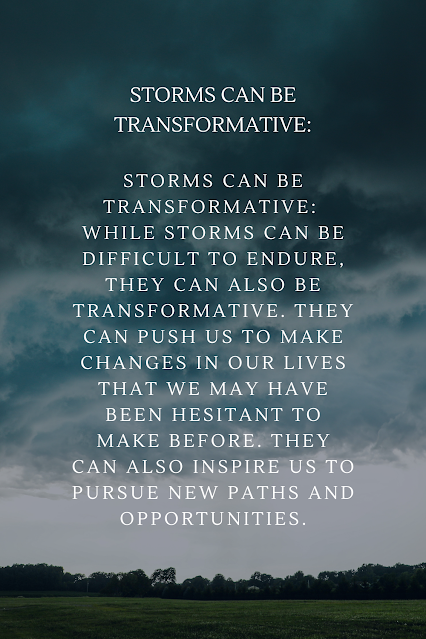
Storms can be transformative: 

While storms can be difficult to endure, they can also be transformative. They can push us to make changes in our lives that we may have been hesitant to make before. They can also inspire us to pursue new paths and opportunities.

Storms help us to appreciate the journey: 

Often, we focus so much on the end goal that we forget to appreciate the journey along the way. Storms can remind us to savor each moment, even the difficult ones, and to appreciate the journey as much as the destination.

Storms remind us of our own strength: 

When we make it through a storm, we are reminded of our own strength and resilience. This can give us the confidence we need to face future challenges with courage and determination.

Storms are a natural part of life: 

Finally, it is important to remember that storms are a natural part of life. We cannot control when they come or how intense they are, but we can control how we respond to them. By cherishing the storm, we can learn and grow from the experience, and come out stronger on the other side.

Conclusion: 

While storms may bring chaos and upheaval, they also provide opportunities for growth and transformation. By cherishing the storm and embracing the challenges it presents, we can learn important lessons about ourselves and the world around us. So, the next time a storm rolls in, instead of fearing it, try to embrace it and see what it has to teach you.


The Life-Changing Power of Cherishing the Storm


The Life-Changing Power of Cherishing the Storm


The Life-Changing Power of Cherishing the Storm

7 Paths to Happiness

Friday, March 6, 2026


7 Paths to Happiness: Your Journey to a Joyful Life
  7 Paths to Happiness: Your Journey to a Joyful Life


Happiness is a feeling that we all strive for, but often find elusive. We may believe that happiness is something that we can only find through external circumstances such as wealth, success, or material possessions. However, the truth is that happiness is a state of mind that comes from within. By embracing the right habits and attitudes, you can cultivate lasting happiness, no matter what life throws your way.

Here are seven paths to happiness that will guide you on your journey to a joyful life:

    Gratitude: The Power of Appreciation


Gratitude is one of the simplest, yet most powerful paths to happiness. By focusing on the things that you are grateful for, you can shift your perspective away from negativity and towards positivity. Start each day by listing three things that you are grateful for, and carry that attitude of appreciation throughout the day.

The journey to gratitude may be difficult at first, especially if you are feeling low or facing challenges. However, with practice, you will find that your outlook becomes increasingly positive, and that you begin to see the good in even the most difficult situations.

    Mindfulness: The Art of Presence


Mindfulness is the practice of being fully present in each moment. When we live in the present, we are not dwelling on the past or worrying about the future. Instead, we are fully engaged in the here and now, and are able to fully experience the joys and beauty of life.

The journey to mindfulness begins with setting aside time each day for meditation or quiet reflection. As you continue to practice mindfulness, you will find that your mind becomes increasingly calm and focused, and that you are able to better appreciate each moment.

    Kindness: The Beauty of Giving


Kindness is one of the most powerful paths to happiness. By giving to others, we not only bring joy to their lives, but we also reap the rewards of increased happiness and well-being for ourselves.

The journey to kindness begins with small acts of generosity, such as holding the door for someone or offering a compliment. As you continue to practice kindness, you will find that your heart becomes filled with a sense of warmth and contentment, and that you are able to better connect with others.

    Exercise: The Magic of Movement


Exercise is not just good for our physical health, but it is also essential for our emotional well-being. When we engage in physical activity, we release endorphins, which are the feel-good chemicals in our brains.

The journey to happiness through exercise begins with setting aside time each day for movement, such as taking a walk, doing yoga, or hitting the gym. As you continue to engage in physical activity, you will find that your mood improves, and that you have more energy and motivation to tackle life's challenges.

    Learning: The Adventure of Discovery


Learning is one of the most rewarding paths to happiness. By continuously expanding your knowledge and skills, you can cultivate a sense of purpose and fulfillment, and stay motivated and engaged in life.

The journey to happiness through learning begins with setting aside time each day for reading, taking courses, or pursuing a hobby. As you continue to learn and grow, you will find that your sense of self-esteem and confidence improves, and that you are able to approach life's challenges with a sense of adventure and excitement.

    Connection: The Strength of Relationships


Connection is one of the most fundamental paths to happiness. By building strong relationships with others, we cultivate a sense of belonging, love, and support that is essential to our well-being. Whether it's spending quality time with loved ones, volunteering in your community, or simply striking up a conversation with a stranger, the act of connecting with others has been shown to improve our mood and increase our overall happiness.

The journey to happiness through connection begins with reaching out to others and being open to new relationships. It may be challenging at first, especially if you are shy or have had negative experiences with relationships in the past. However, with time and effort, you will find that you are able to form strong bonds with others, and that these relationships bring joy and fulfillment to your life. 

Purpose: The Path to Fulfillment


The journey to happiness is one that we all undertake at different points in our lives. By embracing these seven paths - gratitude, mindfulness, kindness, exercise, learning, connection, and purpose - you can cultivate a sense of joy and well-being that will sustain you through even the toughest of times.

Remember, happiness is a journey, not a destination. By taking small steps each day, you can gradually build the habits and attitudes that will bring lasting happiness to your life. So, start your journey today, and let the paths to happiness lead you to a life filled with joy, contentment, and fulfillment.


Winter Reflections And Quotes

Saturday, January 3, 2026


Winter Reflections And Quotes


The cold of winter! it inspires us to burrow into the reassuring embrace of deep contemplation. It's a time for reflection. The frigid season is a subtle reminder that though solitude can be a soothing form of escape rather than an unending prison sentence. Though the weather can be bitter, this time of the year has a way of drawing people together as they seek the comfortable glow of of Christmas lights and the soft light of benevolence. This has always been the season for sipping steaming chocolate milk by the fire, whispered talks under blankets, and hushed stories told while the wind whistles in the distance.


Winter Reflections And Quotes